Bangladesh Spinning, Denim and Knitwear Industry: Market Analysis and Global Share (2026)
Introduction
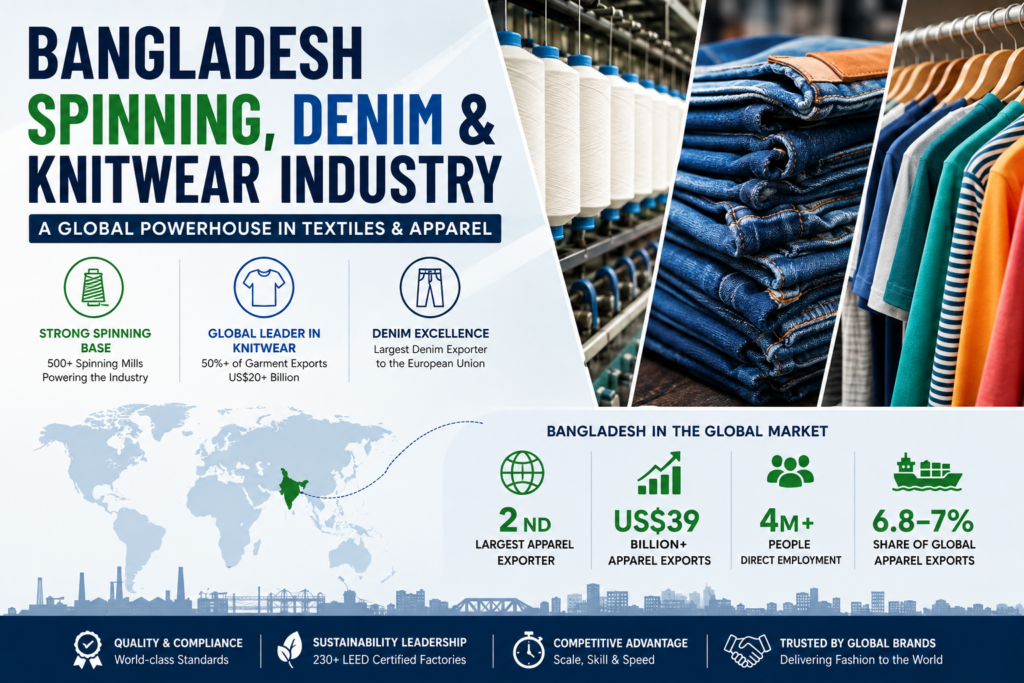
Bangladesh has transformed itself from a low-cost garment manufacturing destination into one of the world’s most important textile and apparel sourcing hubs. Today, the country is the second-largest exporter of ready-made garments (RMG) after China, supported by a strong spinning industry, world-class knitwear manufacturing, and one of the largest denim production clusters globally. The textile and apparel sector is the backbone of Bangladesh’s economy, contributing over 80% of merchandise export earnings while employing more than four million people directly. (Bangladesh.com)
Bangladesh Textile Industry at a Glance
| Indicator | Latest Estimate |
|---|---|
| Global Ranking | 2nd Largest Apparel Exporter |
| Textile & Apparel Export | Approximately US$39 Billion |
| Share of National Exports | Over 80% |
| Direct Employment | 4.0–4.4 Million Workers |
| Number of Garment Factories | Around 3,500–4,000 |
| LEED Certified Green Factories | 230+ (Highest in the World) |
Bangladesh has become the preferred sourcing destination for major international brands including Zara, H&M, Primark, Uniqlo, C&A, Mango, Lidl, Walmart, Tesco, Marks & Spencer, Gap and many others due to competitive pricing, improving compliance, and strong manufacturing capabilities. (Bangladesh.com)
Bangladesh Spinning Industry
Overview
The spinning industry is the backbone of Bangladesh’s textile value chain. More than 500 spinning mills produce cotton, polyester, viscose and blended yarns for domestic knitting and weaving industries.
The country has invested heavily in spinning over the last two decades to reduce dependence on imported yarn.
Current Position
The spinning sector supplies approximately:
- 90% of yarn required by the knitwear industry
- 35–40% of yarn required by woven garment manufacturers
- Remaining woven yarn is imported mainly from India, China, Pakistan, Uzbekistan and Vietnam.
This strong backward linkage is one of Bangladesh’s biggest competitive advantages.
Major Yarn Products
Bangladesh produces:
- Carded Cotton Yarn
- Combed Cotton Yarn
- Compact Yarn
- Open End Yarn
- Slub Yarn
- Mélange Yarn
- Polyester Yarn
- Cotton/Polyester Blends
- Viscose Yarn
- Organic Cotton Yarn
Leading spinning groups continue investing in compact spinning, contamination-free yarn and sustainable production.
Leading Spinning Groups
Some of the country’s largest spinning companies include:
- Noman Group
- Envoy Textiles
- DBL Group
- Square Textiles
- Matin Spinning Mills
- Beximco Textiles
- Fakir Group
- Badsha Group
- NZ Textile
- Paramount Textile
Many operate fully integrated facilities from spinning to finished garments.
Bangladesh Knitwear Industry
Global Leadership
Knitwear remains Bangladesh’s strongest apparel segment.
Recent export data shows:
- Knitwear exports exceeded US$20 billion annually
- Knitwear contributes over 50% of Bangladesh’s garment exports
- Bangladesh is among the world’s largest suppliers of knitted T-shirts, polo shirts, fleece garments, underwear and sportswear. (Bangladesh.com)
Major Knitwear Products
Bangladesh manufactures:
- T-Shirts
- Polo Shirts
- Sweatshirts
- Hoodies
- Leggings
- Underwear
- Sportswear
- Children’s Wear
- Loungewear
- Thermal Wear
Why Buyers Prefer Bangladesh
Key advantages include:
- Strong backward linkage in knitting and dyeing
- Competitive labour costs
- Large production capacity
- Short lead times
- High compliance standards
- Green manufacturing
- Skilled workforce
Bangladesh Denim Industry
A Global Denim Powerhouse
Bangladesh has become one of the world’s largest denim manufacturing hubs.
The country produces:
- Denim fabrics
- Stretch denim
- Organic denim
- Recycled denim
- Sustainable denim
- Fashion denim garments
Bangladesh is recognized for supplying premium denim to Europe’s leading fashion retailers.
Global Market Position
Bangladesh is:
- The largest exporter of denim garments to the European Union
- One of the leading suppliers of denim products to the United States
- Home to some of the world’s most environmentally sustainable denim factories
Industry estimates indicate Bangladesh accounts for roughly one-third of denim imports into the EU, highlighting its dominant position in this product category. (Reddit)
Major Denim Manufacturers
Leading producers include:
- Envoy Textiles
- Pacific Jeans
- Ha-Meem Group
- Shasha Denims
- Noman Group
- Beximco Denim
- Square Denim
- Bitopi Group
- Dekko Group
Bangladesh’s Share in the Global Apparel Market
Bangladesh continues to hold a leading position in global apparel exports.
| Country | Approximate Position |
|---|---|
| China | 1st |
| Bangladesh | 2nd |
| Vietnam | 3rd |
| Turkey | 4th |
| India | 5th |
Recent WTO data indicates Bangladesh’s share of global apparel exports is approximately 6.8–7%, maintaining its second-place ranking, although competition from Vietnam and Cambodia has intensified. (Bangladesh Textile Journal)
Key Export Markets
Bangladesh exports primarily to:
- European Union
- United States
- United Kingdom
- Canada
- Japan
- Australia
The EU remains the largest destination, accounting for nearly half of Bangladesh’s apparel exports. (Fashion Business Journal)
Competitive Advantages
Bangladesh’s success is driven by:
- Large integrated textile supply chain
- Competitive labour costs
- Extensive spinning and knitting capacity
- Modern dyeing and finishing facilities
- High compliance standards
- World’s highest number of LEED-certified garment factories
- Strong expertise in cotton apparel
- Government support for exports
Challenges Facing the Industry
Despite its strengths, the industry faces several challenges:
1. Rising Competition
Vietnam, Cambodia and India are rapidly expanding their market share through free trade agreements and stronger capabilities in man-made fibres. (Bangladesh Textile Journal)
2. Dependence on Cotton
Bangladesh imports nearly all of its raw cotton, exposing mills to global price volatility.
3. Limited MMF Production
Global demand is shifting toward polyester and performance textiles, requiring greater investment in man-made fibre spinning and processing.
4. Energy Costs
Higher electricity and gas costs continue to pressure spinning and textile mills.
5. Post-LDC Graduation
As Bangladesh graduates from Least Developed Country (LDC) status, preferential market access may diminish in some markets, making productivity and trade agreements increasingly important. (BDPolicyLab)
Future Outlook
The long-term outlook remains positive. Growth opportunities include:
- Technical textiles
- Man-made fibre (MMF) apparel
- Sustainable and recycled textiles
- Organic cotton products
- Circular fashion
- Digital manufacturing and automation
- High-value denim
- Performance knitwear
With continued investment in sustainability, technology, and value-added products, Bangladesh is well positioned to retain its leadership in global apparel sourcing.
Conclusion
Bangladesh has built one of the world’s most integrated textile ecosystems. Its spinning industry provides strong backward linkage for knitwear, while the country has emerged as a global leader in knitwear and denim manufacturing. Although competition from Vietnam, India and Cambodia is increasing, Bangladesh’s scale, sustainability credentials, skilled workforce and manufacturing expertise continue to make it a preferred sourcing destination for global fashion brands.
The next phase of growth will depend on expanding into man-made fibres, technical textiles, automation and higher-value apparel. If these investments continue, Bangladesh is likely to strengthen its position as one of the world’s leading textile and apparel manufacturing nations over the coming decade.